
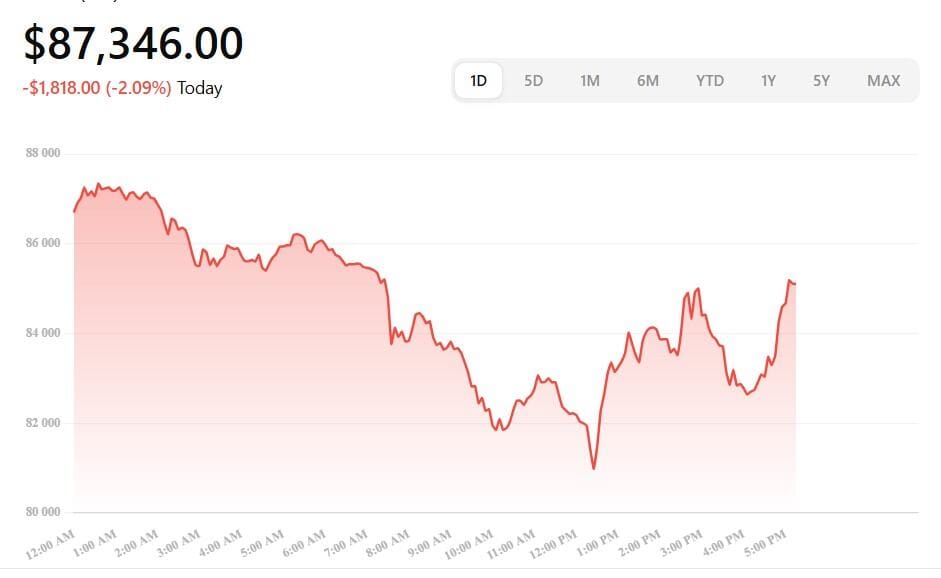
BTC is trading around US $85,106 (as of the most recent update) in the USD market.
Current Price Snapshot
-
Other data sources show prices between ~US $83,000 to US $86,000 for today, 21 November 2025. Reuters+3coindesk.com+3Twelve Data+3
-
It is significantly down from the October highs above US $120,000. Business Insider+1
-
“As of 21 November 2025, Bitcoin is trading around US $83K-US $86K, having dropped from its recent highs above US $120K.”
-
“Analysts now identify key price zones in the US $75K-US $90K range as critical — any break below the lower bound could trigger a sharp pull-back.”
-
“Given the current elevated price level and heavy prior run-up, the risk of a larger correction in Q4 is amplified.
Bitcoin Risks a Major Pullback in Q4 as Bearish Technical Patterns & Macro Uncertainty Converge
As of 21 November 2025, the flagship cryptocurrency Bitcoin (BTC) is trading around US $83,000 – $85,000. Investopedia+1 After peaking above US $126,000 in early October, Bitcoin has lost roughly one-third of its value in a little over six weeks. Investopedia+1
Given this backdrop, Bitcoin appears vulnerable to a sizeable pullback in the fourth quarter, driven by structural chart weakness and growing macroeconomic headwinds.
Technical Vulnerabilities
-
Large gap in derivative market
Market participants continue to monitor a gap left in the Chicago Mercantile Exchange (CME) Bitcoin futures market — a gap at a prior level (historically around US $90K-US $95K) remains unfilled. Historically, CME-futures gaps tend to get closed, and the presence of this open gap suggests an important magnet level for price action. -
Bearish time-frame structures
On the monthly chart, Bitcoin now trades well below its recent highs, and the risk of a sustained red monthly candle is heightened — a signal of bearish momentum. Simultaneously, on the daily chart, Bitcoin has registered multiple lower highs since the October peak (for example, successive highs falling from ~$126K → ~$120K → ~$110K → ~$100K+), creating a classic “lower high” pattern. This reinforces the risk of a near-term downward bias.These combined multi-time-frame patterns (monthly + daily) are significant, since they often mark shifts in broader market phase rather than just short-term corrections.
-
Failed breakout and potential bull trap
Bitcoin made a sharp attempt to clear resistance in October, but the failure to hold above ~US $120,000 and subsequent sharp drop suggests the breakout may have been a “bull trap.” When a key resistance is breached but then rejected, the probability of a deeper correction increases.
Q4 Historical Performance & Cycle Risk
Bitcoin’s historical performance in the fourth quarter has been mixed—and in recent years leaning negative. For instance, over the past two cycles Bitcoin suffered drops of ~42% and ~13% in Q4. Given this precedent, the probability of a slower, risk-off fourth quarter remains elevated.
That said, long-term cycle analysis shows that Bitcoin’s post-halving behavior can diverge from shorter-term seasonal patterns. For example, following the 2016 halving, Bitcoin’s Q4 produced a meaningful rise (from ~US $614 to ~US $998), and the cumulative bull-run lasted ~15 months to the $20K peak. While we are in a post-halving regime (the latest halving occurred in April 2024), the current environment differs markedly—among other things due to heavier macro headwinds and higher starting valuations.
Heightened Macro & Market Uncertainty
Macro risk has mounted significantly heading into the final months of 2025:
-
The rapid appetite for risk assets (including Bitcoin) between March and August 2025 was supported by abundant liquidity, low interest rates and large fiscal stimulus.
-
Now, the landscape has shifted: inflation remains sticky in the US, rate-cut expectations from the Federal Reserve have been scaled back, and fiscal stimulus is limited. These dynamics are weighing on risk-assets broadly. marketwatch.com+1
-
Notably, crypto-markets are increasingly correlated with speculative tech equities and the wider “risk-on” universe. The recent crypto drop has been partly driven by deleveraging, margin-calls and a rotation out of high-beta assets. Reuters+1
As crypto risk sentiment softens, Bitcoin remains exposed to headwinds—particularly if broader financial markets enter a risk-off phase.
Outlook & Key Levels
-
Current trading range: ~US $83K-US $85K.
-
Critical near-term support zones: ~US $75K-US $80K (if pressure continues) and ~US $60K-US $70K in a more severe correction scenario. Business Insider
-
Significant resistance: ~US $100K-US $120K region. A failure to reclaim and hold above this zone underpins the risk of further downside.
-
Recommended stance: Short-term cautious to bearish; medium to long-term still constructive (i.e., accumulation possible), but near-term risks are elevated.
Summary
In summary: Bitcoin is trading well off its October highs and faces multiple technical and macro flags that suggest the fourth quarter could be tough. While a drastic crash isn’t guaranteed, the probability of a meaningful correction is higher than in calmer conditions. Traders and investors may want to adopt a more cautious posture in the near term, while long-term holders may view current weakness as a potential accumulation zone.